Dr. Abrams Delivered You, Treated Your Ear Infections, and Signed Your College Physical. Today That's Four Different People.

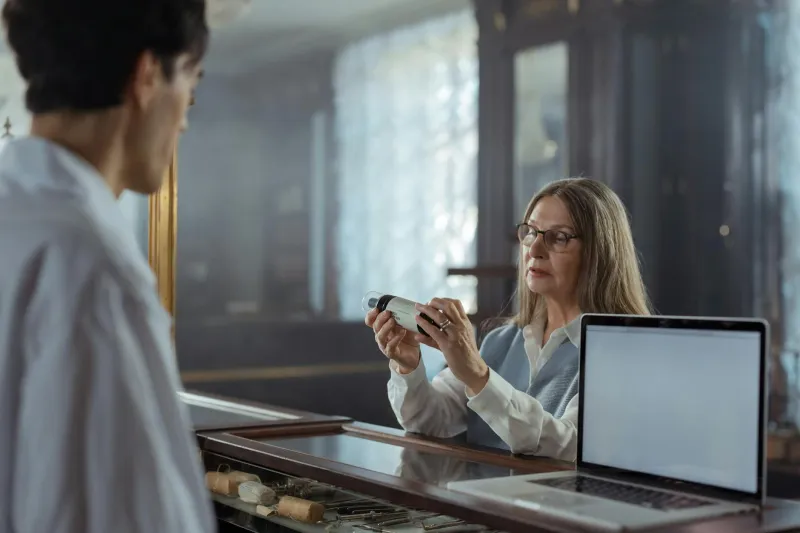
Photo: East Riding Archives, No restrictions, via Wikimedia Commons
The Doctor Who Knew Your Whole Story
In the mid-twentieth century, if you grew up in most American towns, there was a decent chance that the same doctor who caught you in the delivery room also treated your strep throat at age seven, set your broken arm at eleven, and filled out your high school sports physical at sixteen.
He — and it was almost always he, in that era — knew your family the way a good neighbor knows a family. He knew your mother's anxiety about illness, which meant he could calibrate how worried to actually be when she called. He knew your father had a heart condition, which informed how he thought about your own cardiovascular health as you grew. He knew you'd had a febrile seizure at eighteen months, which meant he never treated your fevers as routine.
That accumulation of knowledge wasn't stored in a chart — or rather, it wasn't only stored in a chart. It lived in a relationship. And that relationship shaped every medical decision he made on your behalf.
What Continuity of Care Actually Meant
The concept sounds simple: see the same doctor over time. But the medical value of that continuity was anything but simple.
A physician who has treated a child across ten or twelve years develops a calibrated baseline. She knows what that child's "normal" looks like — their typical energy level, their usual temperament during illness, the way they describe pain. When something deviates from that baseline, a doctor with that history can detect it faster and with more confidence than someone reviewing a chart for the first time.
This matters enormously in pediatrics, where so much diagnosis depends on subjective observation and parental reporting. A child who "just seems off" to a parent is a meaningful signal — but only to a doctor who knows what "on" looks like for that specific child.
Beyond the clinical dimension, there was an emotional architecture to the old model that rarely gets discussed in healthcare policy conversations. Children who saw the same doctor repeatedly developed a level of comfort that made medical visits less traumatic and more productive. They were more likely to describe symptoms accurately. They were less likely to minimize pain or hide concerns. The doctor was a known quantity — someone safe — rather than a stranger in a white coat.
How the System Reorganized Itself
The shift away from that model happened gradually and for reasons that weren't inherently malicious. Medicine became more specialized. The explosion of medical knowledge after World War II meant that no single physician could stay current across all areas of care. Pediatrics itself became a distinct specialty, then subdivided further — pediatric cardiology, pediatric neurology, pediatric endocrinology — as the field deepened.
Insurance networks restructured how Americans accessed care. Group practices replaced solo practitioners. Hospital systems absorbed independent physician offices. Electronic health records were supposed to solve the continuity problem by making a patient's history accessible to any provider in the network — a reasonable theory that has worked better in practice for some things than others.
Urgent care centers proliferated, offering something the traditional model often couldn't: availability. A sick child at 7 p.m. on a Thursday no longer had to wait until morning or head to an emergency room. That's a genuine improvement, especially for working families without flexible schedules.
But the cost of all this reorganization was paid in continuity. The family doctor who knew your whole story gave way to a rotating cast of providers, each of whom knows the chart version of your child rather than the human version.
The Chart Is Not the Child
Electronic health records are genuinely useful. They prevent dangerous drug interactions. They ensure a physician in one state can access relevant history from another. They've reduced certain categories of medical error significantly.
But a chart captures what was documented, not what was observed. It records diagnoses, not the clinical intuition that led to them. It stores test results, not the conversation a doctor had with a nine-year-old about where exactly the stomach hurt and whether it was worse after lunch.
And charts don't capture family context in any meaningful way. The doctor who knew your grandmother died of ovarian cancer, who knew your father struggled with depression in his thirties, who knew your older sibling had a learning disability that went undetected for years — that doctor was carrying information that never made it into any database. He was integrating it continuously, invisibly, into every recommendation he made.
Today, a parent often has to reconstruct that context verbally at the start of every appointment with a provider they've never met. And appointments are short. The average pediatric visit in the United States runs somewhere between fifteen and twenty minutes. There isn't time to rebuild a decade of family health context from scratch.
What Modern Pediatric Care Does Well
Fairness requires acknowledging what's genuinely better. Diagnostic tools available to today's pediatricians would have seemed like science fiction to a 1955 family doctor. Imaging, genetic screening, targeted bloodwork, telemedicine follow-up — these capabilities save lives and catch conditions that would have gone undetected for years in an earlier era.
Vaccine schedules are better managed. Developmental screening is more systematic. Mental health is taken more seriously as a component of pediatric care than it was in a model where a child's emotional state was largely invisible to medicine.
And the old model had real problems that nostalgia tends to smooth over. Solo practitioners burned out. Rural areas were chronically underserved. The relationship-based model worked better for families who were stable, insured, and white. Continuity of care was not equally distributed.
The Thing Worth Recovering
None of that makes fragmentation desirable. It makes it understandable — which is different.
What's worth recovering from the old model isn't the solo practitioner or the house call or the paternalistic physician who didn't explain his reasoning. It's the underlying principle: that knowing a patient over time produces better medicine than treating a chart on a schedule.
Some pediatric practices are moving back toward this — assigning families to a consistent primary physician within a group practice, building in longer well-visit appointments, integrating behavioral health into routine care. These are meaningful steps.
But for most American families today, their child's medical history exists across a pediatrician's office, two urgent care visits, a specialist referral, and a telehealth platform — each holding a piece of a picture that nobody is looking at whole.
Dr. Abrams, whoever he was in your town, was looking at the whole picture. Every time.