When Graduation Day Meant Payday
In 1970, something extraordinary happened to college graduates that seems almost mythical today: companies showed up on campus in spring, conducted interviews, and made job offers before students even walked across the stage. Not internship offers. Not "we'll keep your resume on file" promises. Actual jobs with actual salaries that could support actual adult lives.
Robert Chen graduated from Ohio State in 1972 with a business degree and three job offers. He chose the middle option—a position with a Cleveland manufacturing company that paid $8,500 annually. That salary, adjusted for inflation, equals about $58,000 today. His total college debt? Zero. His parents had paid the $1,100 annual tuition from his father's factory wages.
 Photo: Robert Chen, via www.wfmt.com
 Photo: Ohio State, via wallpapers.com
"I walked into that job on a Monday morning and started earning a living wage immediately," Chen recalls. "No unpaid internships, no 'gaining experience' for two years. They trained me, paid me, and expected me to build a career there."
This wasn't unusual. It was the standard American promise: four years of college education in exchange for guaranteed entry into the middle class.
The Great Credential Inflation
Somewhere between then and now, that promise quietly expired. Today's college graduates face a fundamentally different equation. The average 2023 graduate leaves school with $37,000 in debt, facing an entry-level job market that increasingly demands experience they couldn't possibly have.
Job postings routinely list "entry-level" positions requiring 3-5 years of experience. Unpaid internships have become so normalized that students now compete fiercely for the privilege of working for free. The jobs that do hire new graduates often pay salaries that, adjusted for cost of living, provide less purchasing power than their 1970s counterparts earned.
Meanwhile, college costs have increased at nearly four times the rate of inflation. The same Ohio State education that cost Robert Chen $4,400 total now runs about $45,000 for in-state students. But starting salaries haven't kept pace—they've actually declined in real terms for many majors.
The Numbers Tell the Story
The math is stark. In 1980, the average college graduate could pay off their student loans with 10% of their starting salary over 10 years. Today, that same calculation requires 20% of salary over 20 years. A degree that once cost the equivalent of a nice car now costs as much as a house down payment.
Employers have responded to the flood of college graduates by raising requirements across the board. Jobs that previously hired high school graduates now require bachelor's degrees. Positions that once welcomed bachelor's degree holders now prefer master's degrees. It's credential inflation on a massive scale, and it's left an entire generation overeducated for the jobs available to them.
Sarah Martinez graduated from the University of Texas in 2019 with a communications degree and $32,000 in debt. After six months of job searching, she accepted a marketing coordinator position paying $35,000—barely above what her father earned in a similar role 25 years earlier, despite having significantly more education.
 Photo: University of Texas, via wallpapers.com
"My dad got his job at 22 with a high school diploma and worked his way up," Martinez explains. "I have a college degree and I'm making less than he did, adjusted for inflation. But somehow I'm supposed to feel grateful for the opportunity."
The Internship Industrial Complex
Perhaps nothing illustrates the shift more clearly than the rise of unpaid internships. In the 1970s, summer jobs paid money—often good money. Students worked construction, waited tables, or found temporary office work that covered their expenses and helped pay for school.
Today, students are expected to work for free to gain "valuable experience," often in the same companies that once paid previous generations for similar work. The internship has become a requirement rather than an opportunity, and it's created a system that favors students wealthy enough to work without pay.
This has profound implications for social mobility. Working-class students who need summer income to afford school are effectively shut out of career-building internships, while their wealthier peers accumulate the experience that leads to better job offers after graduation.
The Experience Paradox
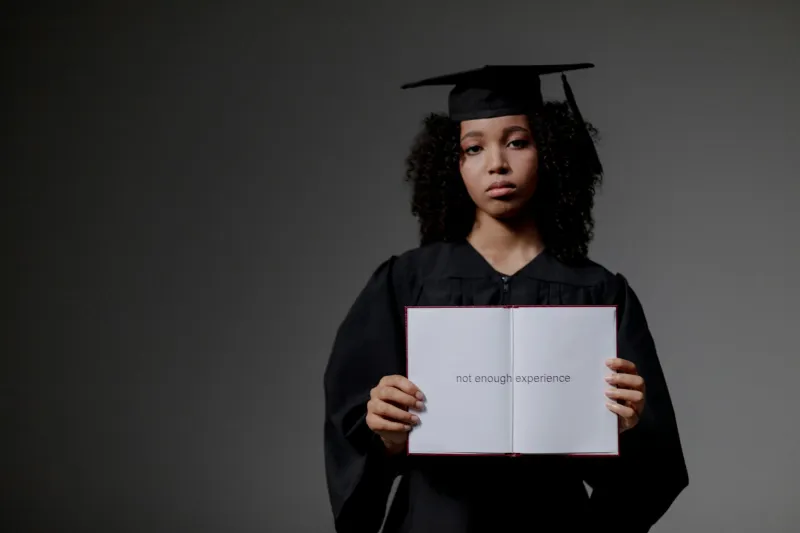
The cruel irony of modern job hunting is that entry-level positions require experience that new graduates can't possibly have. Employers, faced with an oversupply of degree holders, have become increasingly selective. Why hire someone fresh out of college when you can find someone with a degree and three years of experience willing to work for entry-level wages?
This has created what economists call a "experience trap." New graduates can't get jobs without experience, but can't get experience without jobs. The solution, increasingly, is unpaid work, extended periods of underemployment, or returning to school for additional credentials—further delaying entry into the workforce and increasing debt loads.
When Everyone Has a Degree, No One Does
The democratization of higher education—once seen as a triumph of American opportunity—has created unintended consequences. When only 10% of the population had college degrees, those credentials carried real weight in the job market. When 40% have degrees, employers can afford to be choosy.
But the jobs haven't fundamentally changed. Many positions that now require college degrees involve the same tasks they did when high school graduates performed them. The difference is that employers now use education requirements as a screening tool, even when the actual work doesn't require advanced knowledge.
This has created a massive misallocation of human capital. Overqualified workers take jobs that don't utilize their education, while employers complain about skills shortages in trades and technical fields that don't require degrees but offer good wages.
The LinkedIn Generation
Today's graduates don't just compete for jobs—they compete for online presence, networking connections, and personal branding. The simple resume and cover letter that got Robert Chen hired has been replaced by LinkedIn profiles, portfolio websites, and social media audits.
Job searching itself has become a full-time job requiring skills that previous generations never needed. Modern graduates must master applicant tracking systems, optimize their resumes with keywords, and navigate multiple rounds of interviews that often include personality tests, skill assessments, and video screenings.
What Changed the Game
Several factors converged to transform higher education from a pathway to prosperity into a high-stakes gamble. Federal student loan programs made it easier to borrow large sums, enabling colleges to raise prices dramatically. Globalization and technology eliminated many middle-skill jobs that once provided pathways to the middle class without degrees.
Meanwhile, the cultural message that "everyone should go to college" created artificial demand for higher education while diminishing respect for trades and technical careers that often provide better financial returns.
The result is a generation that followed the rules—went to college, earned degrees, accumulated debt—only to discover that the rules had changed while they were in school. The four-year ticket to the middle class became a six-figure gamble with increasingly uncertain odds.
Perhaps most tellingly, many of today's college graduates are considering the trades and technical careers their parents discouraged them from pursuing. The plumber or electrician who skipped college debt might well out-earn the marketing coordinator with a bachelor's degree—and sleep better at night knowing their skills can't be outsourced or automated away.